- Home
- Chronic Conditions
- Asthma/COPD Treatment

Asthma/COPD Treatment
Order Asthma Inhalers & COPD Treatment Online
Medically reviewed by the UK Meds Clinical Team. Last reviewed: 12 August 2026.
In stock for next-day delivery
Asthma and COPD are long-term respiratory conditions that need consistent, ongoing management. There is no cure for either, but the right treatment keeps symptoms under control and helps you stay active. At UK Meds, you can order your regular prescription asthma inhalers and COPD treatment through a safe, regulated online service.
Not sure whether your symptoms could be asthma? Take our "Do I Have Asthma?" quiz, then speak to your GP for a diagnosis.
More Information
At a glance
- Asthma inhalers are prescription-only medicines in the UK. There is no over-the-counter inhaler.
- Current UK guidance (NICE/BTS/SIGN, 2024) advises that everyone with asthma should use an inhaler that contains an inhaled steroid, rather than a reliever on its own.
- Most people now use a combination inhaler for anti-inflammatory reliever (AIR) or maintenance and reliever therapy (MART).
- COPD is a separate condition, mainly linked to smoking, and is managed with bronchodilators and, for some people, combination inhalers.
- Your prescriber or GP decides which treatment is right for you, based on your diagnosis and symptoms.
How to Order Asthma & COPD Treatment Online
You can order asthma inhalers and COPD treatment online through UK Meds if you already have a diagnosis and know which medicine you need. Because inhalers are prescription-only, a registered prescriber reviews your online assessment before any medicine is dispensed. This means you can reorder your regular bronchial asthma or COPD treatment without a face-to-face appointment, while keeping a clinician in the loop. Our prescribers cannot diagnose asthma or COPD, so you will need an existing diagnosis.
How our service works:
- You complete a short online medical assessment about your health and current treatment.
- A registered independent prescriber reviews your assessment and, if the medicine is suitable for you, issues a prescription.
- A GPhC-registered partner pharmacy dispenses and ships your treatment.
UK Meds is a regulated online prescription service, not an online pharmacy. Our prescribers consult and prescribe; the partner pharmacy dispenses.
Quick Inhaler Finder: Which Type Do You Need?
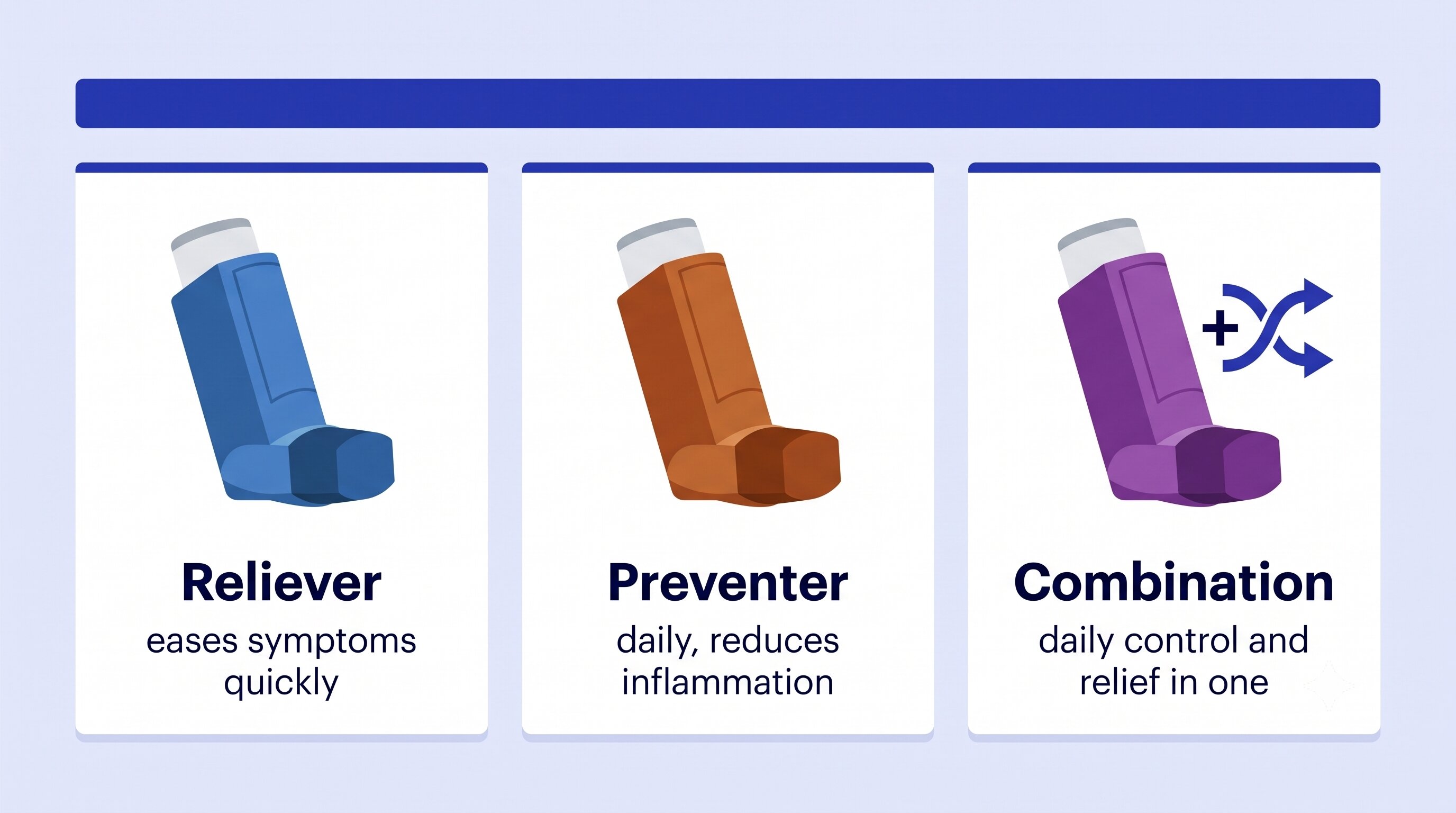
Inhalers are grouped by what they do, and colour can help you recognise yours. Use this quick guide to match your prescribed inhaler to its type, then read the full treatment section below to understand how each one is used today.
| Inhaler Type | Common Colours | What It Does | Popular Brands |
|---|---|---|---|
| Reliever | Blue | Eases wheezing and tightness quickly. Sometimes called an asthma pump. Current guidance advises against using one on its own for asthma. | Ventolin, Salamol |
| Preventer | Brown, orange or red | Taken daily to reduce inflammation and prevent symptoms and attacks. | Clenil, Qvar, Flixotide |
| Combination | Purple, red/white or pink | Contains a steroid and a long-acting bronchodilator. Some are used for both daily control and relief. | Seretide, Symbicort, Fostair |
Video: Understanding Your Asthma Inhaler
Not sure which inhaler does what? Watch our guide to understanding the difference between the blue asthma inhaler (reliever) and brown preventers.
What Is Asthma?
Asthma is a common, long-term respiratory condition that causes breathing difficulties when the airways become inflamed and narrow. It affects people of all ages and often begins in childhood, though it can start at any age[1]. The airways of someone with asthma are sensitive, so they tighten when exposed to asthma triggers such as pollen, dust mites, cold air or exercise. The exact cause is not fully understood, but genetics and environmental factors such as pollution both play a part[2].
Types of Asthma
There are several recognised types of asthma, usually grouped by what triggers the symptoms.
- Allergic asthma: Triggered by allergens such as pollen, dust mites or animal fur.
- Exercise-induced asthma: Symptoms appear during or after physical activity, or in cold air.
- Occupational asthma: Caused by breathing in irritants such as fumes, flour, wood dust or chemicals at work[3].
- Cough-variant asthma: The main symptom is a persistent dry cough rather than obvious wheezing.
- Nocturnal asthma: Symptoms are worse at night, disturbing sleep.
- Severe or brittle asthma: A rarer, harder-to-control form where serious attacks can happen suddenly.
Common Symptoms of Asthma
The most common symptoms of asthma are coughing, wheezing, breathlessness and a tight chest[4]. Symptoms often come and go and can vary in severity over time. On average, asthma is linked to around three deaths a day in the UK[5], which is why keeping it well controlled with the right treatment matters.
"If you find yourself reaching for a reliever inhaler three or more times a week, that is a sign your asthma is not as well controlled as it should be. It is not a reason to simply use more reliever. It is a prompt to have your treatment reviewed, because good control usually means needing your reliever rarely."
- UK Meds Clinical Team
What Is COPD?
Chronic obstructive pulmonary disease (COPD) is the name for a group of long-term lung conditions, mainly emphysema and chronic bronchitis, that cause breathing difficulties. Unlike asthma, COPD usually affects middle-aged and older adults, and it is closely linked to smoking. It is diagnosed with a breathing test called spirometry. Smoking is the main cause of COPD in the UK[6], and COPD treatment focuses on easing symptoms, reducing flare-ups and protecting quality of life.
Asthma vs COPD: What Is the Difference?
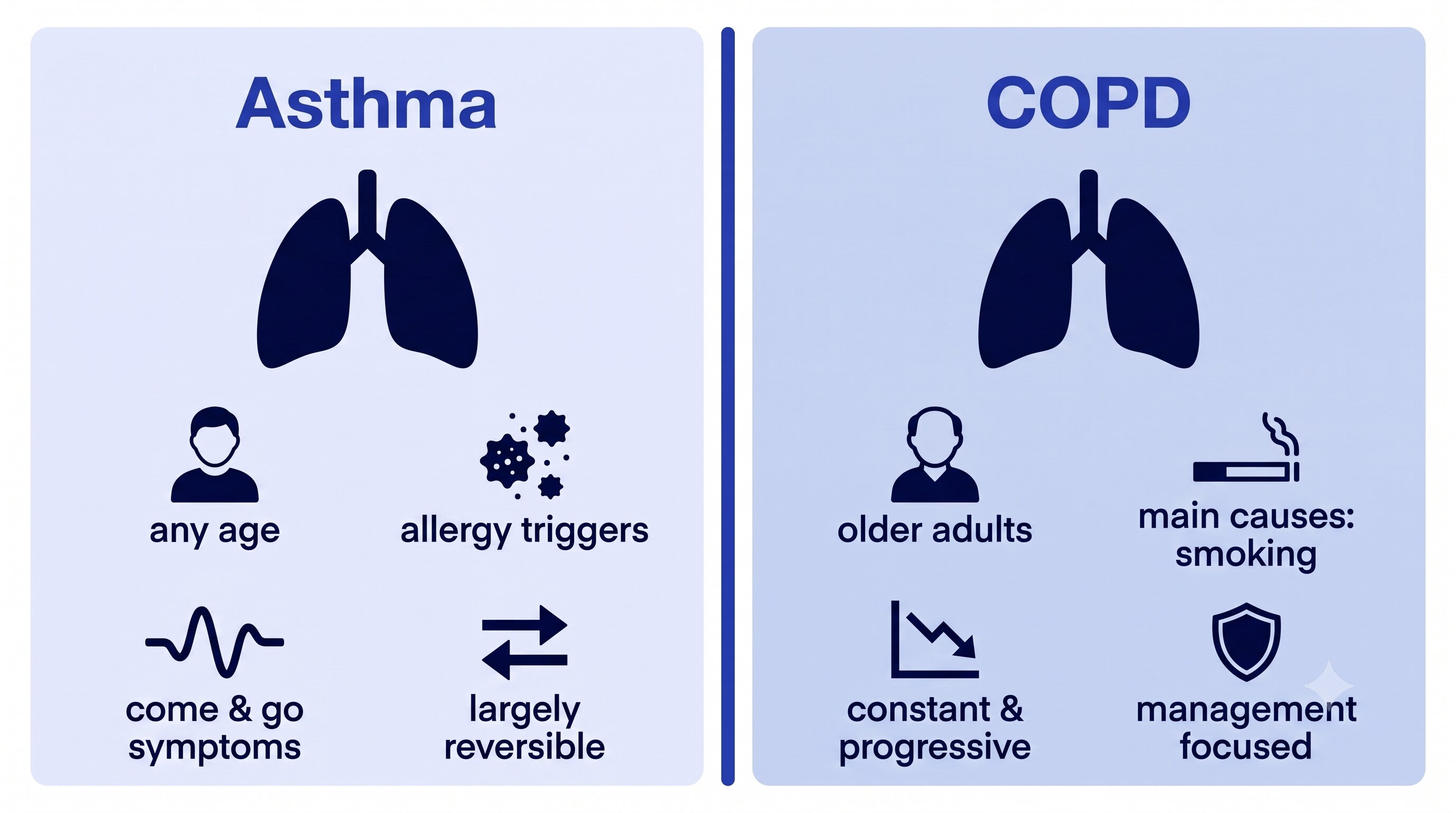
The main difference between asthma and COPD is that asthma symptoms come and go and usually respond well to treatment, while COPD involves longer-term, less reversible damage to the airways. Both cause breathlessness, coughing and a tight chest, so they can be confused, but the causes, typical age of onset and treatments differ. The table below sets out the key contrasts.
| Feature | Asthma | COPD |
|---|---|---|
| Typical age of onset | Often childhood, but any age | Usually over 35 |
| Main cause | Airway inflammation and sensitivity, often with allergy | Long-term lung damage, mainly from smoking |
| Symptom pattern | Comes and goes, varies day to day | More constant, tends to worsen slowly over time |
| Reversibility | Largely reversible with treatment | Only partly reversible; managed rather than cured |
| Key treatments | Inhaled steroid, usually in a combination inhaler (AIR or MART) | Long-acting bronchodilators, with combination inhalers for some |
"Asthma and COPD can look similar from the outside, because both cause breathlessness, coughing and a tight chest. The key difference is that asthma symptoms tend to come and go and usually respond well to treatment, while COPD involves longer-term damage to the airways that we manage rather than reverse. Getting the right diagnosis matters, because the treatments are not the same."
- UK Meds Clinical Team
Asthma & COPD Treatments Explained
Asthma and COPD are treated mainly with inhalers, and current UK guidance has changed how asthma inhalers are used. For asthma, the 2024 NICE, BTS and SIGN asthma guideline now recommends that everyone uses an inhaler containing an inhaled steroid, rather than relying on a blue reliever on its own, because treating the underlying inflammation is what keeps symptoms and attacks under control. For COPD, treatment centres on long-acting bronchodilators, with combination inhalers added for some people. Your prescriber or GP decides which approach and which inhaler suits you.
"For years, the advice was that everyone with asthma should carry a blue reliever inhaler and use a separate brown preventer. That thinking has changed. We now know that treating the underlying inflammation matters from day one, so current UK guidance recommends that everyone with asthma uses an inhaler containing a low dose of steroid, rather than a reliever on its own. If you are still using a blue inhaler by itself, please book an asthma review so your treatment can be brought up to date."
- UK Meds Clinical Team
Anti-Inflammatory Reliever (AIR) Therapy
Anti-inflammatory reliever therapy, or AIR, means using a single combination inhaler only when you have symptoms, in place of the old blue-reliever-only approach. Because the inhaler contains a low dose of steroid alongside a fast-acting bronchodilator (formoterol), it treats inflammation at the same time as easing symptoms. Trials including SYGMA 1[11] and Novel START[12] found this as-needed approach reduced severe asthma attacks compared with a reliever alone, and it is now a first-line option for many adults and teenagers with asthma under current UK guidance.
Maintenance and Reliever Therapy (MART)
Maintenance and reliever therapy, or MART, means using one combination inhaler every day to prevent symptoms and also using the same inhaler for relief when symptoms occur. It replaces the older pattern of a separate daily preventer plus a blue reliever, and a 2018 review of MART trials[13] found it reduced asthma attacks compared with higher-dose steroids plus a separate reliever. Only combination inhalers that contain formoterol can be used this way, because formoterol works quickly enough to relieve symptoms. If you are prescribed a MART inhaler, you should not usually need a separate blue reliever.
Reliever Inhalers (Short-Acting Bronchodilators)
Reliever inhalers contain a fast-acting bronchodilator, such as salbutamol, that relaxes the muscles around the airways within minutes. They are usually blue, but not always. For asthma, current guidance advises against using a short-acting reliever on its own, because over-reliance on a reliever is linked to a higher risk of asthma attacks and death[14], and a bronchodilator without an inhaled steroid does not treat the underlying inflammation. Short-acting bronchodilators still have a role in COPD and in some treatment plans, always alongside preventer treatment for asthma.
Preventer Inhalers (Inhaled Corticosteroids)
Preventer inhalers contain a corticosteroid (an inhaled steroid) that reduces inflammation and calms the airways over time. They are usually brown, orange or red, and are taken every day, even when you feel well, to build up and maintain protection against attacks. Some people use a separate preventer alongside a reliever, while many now use a single combination inhaler instead.
Combination Inhalers
Combination inhalers contain both an inhaled steroid and a long-acting bronchodilator in one device. They keep the airways open for longer, typically 12 to 24 hours depending on the inhaler, so once-daily options are available as well as twice-daily ones. Combination inhalers that contain formoterol can be used for AIR or MART, while others are taken daily for prevention with a separate reliever for symptoms. Your prescriber will tell you exactly how to use yours.
Long-Acting Bronchodilators for COPD
COPD is treated mainly with long-acting bronchodilators, which open the airways and are taken regularly. These include long-acting beta-agonists (LABAs) such as olodaterol, and long-acting antimuscarinics (LAMAs) such as tiotropium and umeclidinium. Some people use a LABA and a LAMA together, and some use triple therapy that adds an inhaled steroid, particularly if they have frequent flare-ups; large trials such as IMPACT[15] and ETHOS[16] found triple therapy reduced flare-ups in COPD. A mucolytic such as carbocisteine may also be prescribed to loosen mucus. COPD treatment follows the NICE COPD guideline and is tailored to your symptoms and how often you have flare-ups.
Add-On Treatments
If inhalers alone do not control symptoms, a clinician may add further treatment. This can include montelukast, a leukotriene receptor antagonist tablet, or a short "rescue" course of oral steroid tablets such as prednisolone during a flare-up. For severe asthma, specialist teams may use injections such as omalizumab, mepolizumab, benralizumab or dupilumab, which are started and monitored in hospital and are not part of an online service. The decision to use additional treatments should be made by your doctor.
Please note: Montelukast can rarely cause changes in mood or behaviour. If you or your child notice new mood changes while taking it, seek advice from a healthcare professional, in line with MHRA guidance.
Full List of Asthma & COPD Treatments Available
We can dispense a wide range of inhalers and tablets against a valid prescription. Use this list to check whether we carry your prescribed medicine and to see its active ingredients. Your prescriber decides which treatment is right for you.
| Product Name | Active Ingredients | Form & Doses |
|---|---|---|
| Reliever Inhalers (Short-Acting Bronchodilators) | ||
| Ventolin Evohaler | Salbutamol | 100mcg Evohaler |
| Salamol | Salbutamol sulfate | 100mcg (CFC-free) |
| Airomir Autohaler | Salbutamol sulfate | 100mcg Autohaler |
| Bricanyl Turbohaler | Terbutaline sulfate | 500mcg |
| Atrovent | Ipratropium bromide (short-acting antimuscarinic, mainly used for COPD) | 20mcg |
| Preventer Inhalers (Inhaled Corticosteroids) | ||
| Clenil Modulite | Beclometasone dipropionate | 50, 100, 200, 250mcg |
| Qvar | Beclometasone dipropionate | 50mcg, 100mcg (Easi-Breathe) |
| Flixotide | Fluticasone propionate | 50, 100, 250, 500mcg (Evohaler/Accuhaler) |
| Pulmicort | Budesonide | 100, 200, 400mcg Turbohaler |
| Kelhale | Beclometasone dipropionate | 50mcg, 100mcg |
| Alvesco | Ciclesonide | 80mcg, 160mcg |
| Combination Inhalers (Steroid + Long-Acting Bronchodilator) | ||
| Seretide | Salmeterol / fluticasone | 50, 125, 250mcg (Evohaler/Accuhaler) |
| Symbicort | Budesonide / formoterol | 100/6, 200/6, 400/12 (Turbohaler) |
| Fostair | Beclometasone / formoterol | 100/6, 200/6 (NEXThaler / MDI) |
| DuoResp Spiromax | Budesonide / formoterol | 160/4.5, 320/9 |
| Relvar Ellipta | Fluticasone furoate / vilanterol | 92/22, 184/22 |
| Flutiform | Fluticasone / formoterol | 50/5, 125/5, 250/10 |
| Sirdupla | Salmeterol / fluticasone | 25/125, 25/250 |
| Sereflo | Salmeterol / fluticasone | 25/125, 25/250 |
| AirFluSal | Salmeterol / fluticasone | 25/125, 25/250 |
| Luforbec | Beclometasone / formoterol | 100/6 (MDI) |
| Aerivio Spiromax | Salmeterol / fluticasone | 50/500 |
| COPD & Long-Acting Bronchodilator Inhalers | ||
| Spiriva Respimat | Tiotropium (LAMA) | 2.5mcg soft mist inhaler |
| Spiolto Respimat | Tiotropium / olodaterol (LAMA/LABA) | 2.5/2.5mcg soft mist inhaler |
| Striverdi Respimat | Olodaterol (LABA) | 2.5mcg soft mist inhaler |
| Incruse Ellipta | Umeclidinium (LAMA) | 55mcg |
| Serevent | Salmeterol (LABA) | 25mcg Evohaler |
| Add-On Tablets & Capsules | ||
| Montelukast | Montelukast sodium | 10mg tablets |
| Carbocisteine | Carbocisteine (mucolytic) | 375mg capsules |
Inhaler Devices Explained
Inhalers come in several different device types, and the right technique depends on which one you use. Some inhalers push the medicine out using a propellant, while others release it when you breathe in. Choosing a device you can use well is just as important as choosing the right medicine.
Pressurised Metered-Dose Inhalers (pMDIs)
A pressurised metered-dose inhaler is the classic "spray" inhaler, with a metal canister in a plastic holder. It releases a measured puff of medicine when you press the canister, so you need to press and breathe in slowly at the same time. A spacer makes this much easier and helps more of the medicine reach your lungs.
Dry Powder Inhalers (DPIs)
A dry powder inhaler delivers the medicine as a fine powder that you draw in with a quick, deep breath. Turbohaler, Accuhaler, Ellipta, Spiromax and NEXThaler devices are all dry powder inhalers. They are breath-activated, so there is no need to press and breathe at the same time. They must be kept dry.
Soft Mist Inhalers (SMIs)
A soft mist inhaler turns liquid medicine into a slow-moving mist that is easier to inhale. Respimat devices, such as Spiriva, Spiolto and Striverdi, are soft mist inhalers. These are often used for COPD. Because the mist is released slowly, you breathe in gently and steadily rather than quickly. Soft mist inhalers do not need a spacer.
Spacers, Peak Flow Meters and Nebulisers
A spacer is a plastic chamber that attaches to a pMDI to make it easier to use and to help the medicine reach your lungs rather than your throat. For delivering a reliever in an asthma attack, a spacer can work as well as a nebuliser[17]. Spacers are only used with pMDIs, not with dry powder or soft mist inhalers. A peak flow meter is a small device that measures how fast you can breathe out, which helps you and your clinician track your asthma control. A nebuliser turns liquid medicine into a mist to breathe through a mask, and is usually only needed in specific situations advised by a healthcare professional.
How to Use Your Inhaler (Technique)
Good inhaler technique matters because it decides how much medicine reaches your lungs rather than your throat. A systematic review of 40 years of inhaler use[18] found only about a third of people use their device correctly, so if your technique is poor, even the right inhaler will not work as well as it should. The basic steps depend on your device type.
"The single most common reason an inhaler seems not to work is technique. If the medicine lands on the back of your throat instead of reaching your lungs, even the right inhaler will underperform. It is always worth asking a pharmacist to watch you use your device, and a spacer can make a real difference with spray inhalers."
- UK Meds Clinical Team
For a pressurised metered-dose inhaler (spray):
- Remove the cap and shake the inhaler.
- Breathe out gently, away from the inhaler.
- Put your lips around the mouthpiece and start to breathe in slowly.
- Press the canister once as you keep breathing in slowly and deeply.
- Hold your breath for about 10 seconds, then breathe out gently.
- If it is a steroid inhaler, rinse your mouth with water afterwards.
For a dry powder inhaler: Load the dose as shown in the instructions, breathe out gently away from the device, then take a quick, deep breath in through the mouthpiece and hold for about 10 seconds. Never breathe out into a dry powder inhaler.
For a soft mist inhaler: Prepare the dose, breathe out gently, then breathe in slowly and steadily as you release the mist, and hold your breath for about 10 seconds.
Some inhalers are breath-activated while others need you to press and breathe together. If you are unsure, check the patient information leaflet provided with your medication, or ask a pharmacist.
How to Clean Your Inhaler
How you clean your inhaler depends on the device type, and cleaning the wrong way can stop it working. Always follow the patient information leaflet that comes with your inhaler, and use the general guidance below.
Pressurised metered-dose inhalers (spray inhalers)
Clean these about once a week.
- Remove the metal canister from the plastic casing. Do not wash the metal canister.
- Take off the mouthpiece cover.
- Rinse the plastic casing under warm running water.
- Let it air dry completely before putting it back together.
- Once dry, refit the canister, shake, and release one test spray away from your face.
Dry powder inhalers
Never wash a dry powder inhaler or let it get wet. This is because moisture ruins the powder. Instead, wipe the mouthpiece with a clean, dry tissue or cloth, and keep the device in a dry place.
Soft mist inhalers (Respimat)
Wipe the mouthpiece, including the metal part inside, with a damp cloth or tissue at least once a week. Do not rinse or submerge the device. Follow the specific instructions in the leaflet.
Looking After Your Inhaler: Doses, Storage and When to Replace
Looking after your inhaler helps it deliver the right dose every time and reminds you when to reorder. Two simple habits make the biggest difference: keeping track of your doses and storing the inhaler correctly.
Keeping track of your doses
If your inhaler has a dose counter, use it to see how many doses are left. Many inhalers show a red zone at around the last 20 doses, which is your prompt to order a replacement so you never run out. It is sensible to keep a spare inhaler as a backup. You can also estimate how long an inhaler will last by dividing the total number of doses by how many puffs you use each day. For example, a 120-dose inhaler used four times a day lasts about 30 days, though a MART inhaler may run down faster if you also use it for relief.
How to store your inhaler
- Keep it at room temperature, away from extreme heat or cold.
- Store it somewhere dry and out of direct sunlight. Avoid the bathroom, as damp can affect the medicine.
- Replace the mouthpiece cover after use to keep out dust and debris.
- Keep it out of reach of children and pets.
When to replace your inhaler
Replace your inhaler when the dose counter reaches zero, when it passes its expiry date, if it has been damaged or has got wet, or if it has not been used for a long time.
Disposing of Your Inhaler Safely
Old inhalers should be returned to a pharmacy rather than thrown in your household or recycling bin. Many inhalers use propellant gases that are powerful greenhouse gases, so binning them releases those gases and harms the environment. Any local pharmacy can take back used or unwanted inhalers and dispose of them safely, where the harmful gases are destroyed. Returning your inhalers is a small, free step that reduces their environmental impact.
The Asthma Action Plan
An asthma action plan is a personalised guide you create with your doctor or asthma nurse. It sets out your daily treatment, how to spot when your asthma is getting worse, and what to do if it does. Attending your annual asthma review keeps this plan up to date. You can download a free template from Asthma + Lung UK.
Asthma and Pregnancy
If you are pregnant or trying to become pregnant, you should usually keep taking your asthma inhalers as prescribed, because well-controlled asthma is safer for you and your baby than uncontrolled symptoms. Most inhalers are considered safe to use during pregnancy, but you should not stop or change your treatment without advice. Some people find their asthma improves in pregnancy, while others find it worsens, so close monitoring helps. Our prescribers do not manage asthma in pregnancy through this service, so please speak to your GP, asthma nurse or midwife.
"If you are pregnant or planning a pregnancy, please keep taking your asthma inhalers as prescribed unless your doctor tells you otherwise. Poorly controlled asthma carries more risk to you and your baby than the inhalers themselves. Your GP or midwife will help you keep your asthma well managed throughout."
- UK Meds Clinical Team
Inhaler Side Effects
Inhalers can cause side effects, though not everyone gets them, and good technique helps keep the risk low. Side effects vary by the type of medicine in the inhaler.
Reliever inhalers (for example, salbutamol)
- Common: Headache, feeling shaky (tremor).
- Uncommon: Muscle cramps, throat irritation.
- Rare: Fast heartbeat (palpitations) or low potassium.
Preventer inhalers (inhaled steroids)
- Common: Oral thrush, a hoarse voice or a sore throat. Rinsing your mouth after use helps prevent this.
- Uncommon: Mild allergic reactions such as a rash.
Combination inhalers
- Common: A mix of the above, such as tremor, thrush, a hoarse voice, a mild sore throat or headache.
Always read the patient information leaflet for your specific inhaler. If you have severe side effects or signs of an allergic reaction, seek medical attention straight away.
Healthy Habits for Better Control
Alongside your medicine, everyday lifestyle changes can improve your lung health and asthma control.
- Quit smoking: Stopping smoking is the single most effective step to slow lung damage, especially with COPD[7].
- Stay active: Regular physical activity is linked to better asthma control and quality of life[8]. If you have exercise-induced asthma, speak to your doctor first[9].
- Breathing exercises: Techniques such as diaphragmatic breathing may help improve quality of life[19], alongside your inhalers rather than instead of them[10].
Living with a long-term lung condition can affect your mental health too. If you are struggling, support is available.
Frequently Asked Questions
Can I get an over-the-counter asthma inhaler?
No, there is no over-the-counter asthma inhaler in the UK. All inhalers, including salbutamol and Clenil Modulite, are classified as prescription-only medicines. You can order them online from UK Meds by completing a medical assessment that an independent prescriber reviews.
What is the best inhaler for asthma?
There is no single best inhaler for asthma, because the right one depends on your diagnosis, your symptoms and how well your asthma is controlled. Current UK guidance favours a combination inhaler containing an inhaled steroid and formoterol, used as anti-inflammatory reliever (AIR) or maintenance and reliever therapy (MART), for many adults and teenagers. Your prescriber or GP chooses the inhaler and device that suit you best, and a device you can use well matters as much as the medicine inside it.
Do I still need a blue reliever inhaler?
Not always. Under current UK guidance, many people use a single combination inhaler for both control and relief (AIR or MART) and do not need a separate blue reliever. If you are still using a blue inhaler on its own, it is worth booking an asthma review so your treatment can be updated. Never stop or change your inhalers without professional medical advice.
What are AIR and MART therapy?
AIR and MART are current ways of using a single combination inhaler for asthma. AIR (anti-inflammatory reliever) means using a combination inhaler only when you have symptoms. MART (maintenance and reliever therapy) means using the same inhaler every day and also for relief when needed. Both treat inflammation and symptoms together, which is why they have replaced the older blue-reliever-only approach.
How long does an asthma inhaler last?
Inhaler duration depends on how many doses the inhaler holds and how many puffs you use each day. Divide the total number of doses by your daily puffs to estimate the number of days it will last. For example, 120 doses used four times a day means your inhaler should last about 30 days. A MART inhaler may last less time if you also use it for symptom relief.
Can I use a spacer with any inhaler?
No, a spacer is only used with a pressurised metered-dose inhaler (a spray inhaler). Dry powder inhalers and soft mist inhalers do not use a spacer. A spacer makes a spray inhaler easier to use and helps more of the medicine reach your lungs.
Is there a natural treatment for an asthma attack?
No, there is no proven natural treatment for an asthma attack. An attack is a medical emergency that needs a fast-acting bronchodilator. Relying on natural remedies during an attack can be dangerous. If your reliever is not helping, call 999.
Can asthma go away?
Sometimes. Childhood asthma can improve or disappear in adulthood, but for many people it is a lifelong condition that is managed rather than cured. COPD does not go away and needs long-term management.
Is asthma a disability?
It can be. Asthma may be considered a disability under the Equality Act 2010 if it has a substantial and long-term adverse effect on your ability to carry out normal day-to-day activities.
Final Thoughts From Our Clinical Team
"Asthma is best controlled by treating the inflammation in your airways, not just the symptoms. That is why current UK guidance recommends that everyone with asthma uses an inhaler containing a steroid, and why we would gently encourage anyone still relying on a blue reliever alone to have their treatment reviewed. Use your preventer or combination inhaler exactly as prescribed, even on the days you feel completely well, because that is what keeps you well. Learn your personal action plan, keep a spare inhaler, and go to your annual review so your treatment stays right for you. COPD is managed a little differently, but the same principle applies: steady, consistent treatment protects your lungs over the long term. We are here to help you get your regular medicine safely and conveniently, but we are not a replacement for your own GP or asthma nurse, and we are never a substitute for calling 999 in an emergency. If your breathing suddenly worsens and your reliever is not helping, please get emergency help straight away."
- UK Meds Clinical Team
UK Meds Asthma & COPD Resource Hub
Understanding Asthma & COPD
Managing Asthma & Your Wellbeing
Treatments & Inhalers Compared
Using Ventolin & Reliever Inhalers
Ordering & Prescriptions
Our Service
References & Sources
- Asthma overview: NHS - "Asthma." NHS.uk.
- Asthma causes: Spencer & Krieger (2013) - "Causes of asthma development." NCBI.
- Occupational asthma: HSE - "Occupational asthma." Health and Safety Executive.
- Symptoms: Patient.info - "Asthma." Patient.info.
- Mortality statistics: NHS England - "RightCare asthma scenario." NHS England.
- Smoking & COPD: GOV.UK - "Chronic smoking-related lung disease." GOV.UK.
- Smoking damage: Perret et al. (2016) - "Smoking and lung function." NCBI.
- Exercise benefits: Stoodley et al. (2019) - "Physical activity and asthma control." NCBI.
- Physical training: Panagiotou et al. (2020) - "Exercise training in asthma." NCBI.
- Breathing exercises: Santino et al. (2020) - "Breathing exercises for adults with asthma." PubMed.
- AIR therapy (SYGMA 1): O'Byrne PM, et al. (2018) - "Inhaled combined budesonide-formoterol as needed in mild asthma." N Engl J Med.
- As-needed ICS-formoterol (Novel START): Beasley R, et al. (2019) - "Controlled trial of budesonide-formoterol as needed for mild asthma." N Engl J Med.
- MART evidence: Sobieraj DM, et al. (2018) - "Inhaled corticosteroids and long-acting beta-agonists as controller and quick relief therapy in persistent asthma: a systematic review and meta-analysis." JAMA.
- Reliever overuse (SABINA): Nwaru BI, et al. (2020) - "Overuse of short-acting beta-2-agonists in asthma is associated with increased risk of exacerbation and mortality." Eur Respir J.
- COPD triple therapy (IMPACT): Lipson DA, et al. (2018) - "Once-daily single-inhaler triple versus dual therapy in patients with COPD." N Engl J Med.
- COPD triple therapy (ETHOS): Rabe KF, et al. (2020) - "Triple inhaled therapy at two glucocorticoid doses in moderate-to-very-severe COPD." N Engl J Med.
- Spacers versus nebulisers: Cates CJ, et al. (2013) - "Holding chambers (spacers) versus nebulisers for beta-agonist treatment of acute asthma." Cochrane Database Syst Rev.
- Inhaler technique: Sanchis J, et al. (2016) - "Systematic review of errors in inhaler use: has patient technique improved over time?" Chest.
- Breathing retraining: Bruton A, et al. (2018) - "Physiotherapy breathing retraining for asthma: a randomised controlled trial." Lancet Respir Med.
Further guidance
Our Commitment to Content Accuracy
UK Meds is committed to clear, accurate and up-to-date medical information, in line with our Editorial Policy and Content Policy. This page is reviewed by the UK Meds Clinical Team and updated when medical guidance changes, so you can make informed decisions before starting a consultation with a registered prescriber.
Medical disclaimer: The information on this page is not a substitute for medical advice. Always speak to a doctor, pharmacist or healthcare professional before starting any treatment.
Page last reviewed: 12 August 2026.
Author



Medication delivered the next day from UK pharmacies



Choose the right treatment
From the comfort of your own home or out on the go, choose the treatment you require from our extensive range.
Complete an online consultation
A vital part of our process, your online consultation will be similar questions to that of a GP. Quick and easy, we guarantee privacy and confidentiality.
Delivered discreetly
One of over 100 of our partner regulated UK pharmacies will dispense and ship the treatment to you in discreet packaging.
Here to help you
Our Customer Service is available Monday to Friday 9am - 5pm. If you need urgent assistance, do not use this service. Call 111, or in an emergency call 999. Visit our help section

